

Advanced Option Chain
Explore detailed option chains with real-time data.

Unlock the Power of F&O with PhonePe Invest
START TRADING Be a part of our 3 Million+ family




Explore detailed option chains with real-time data.

Leverage your portfolio to unlock more trading power.

Take advantage of F&O trading on NSE and BSE.



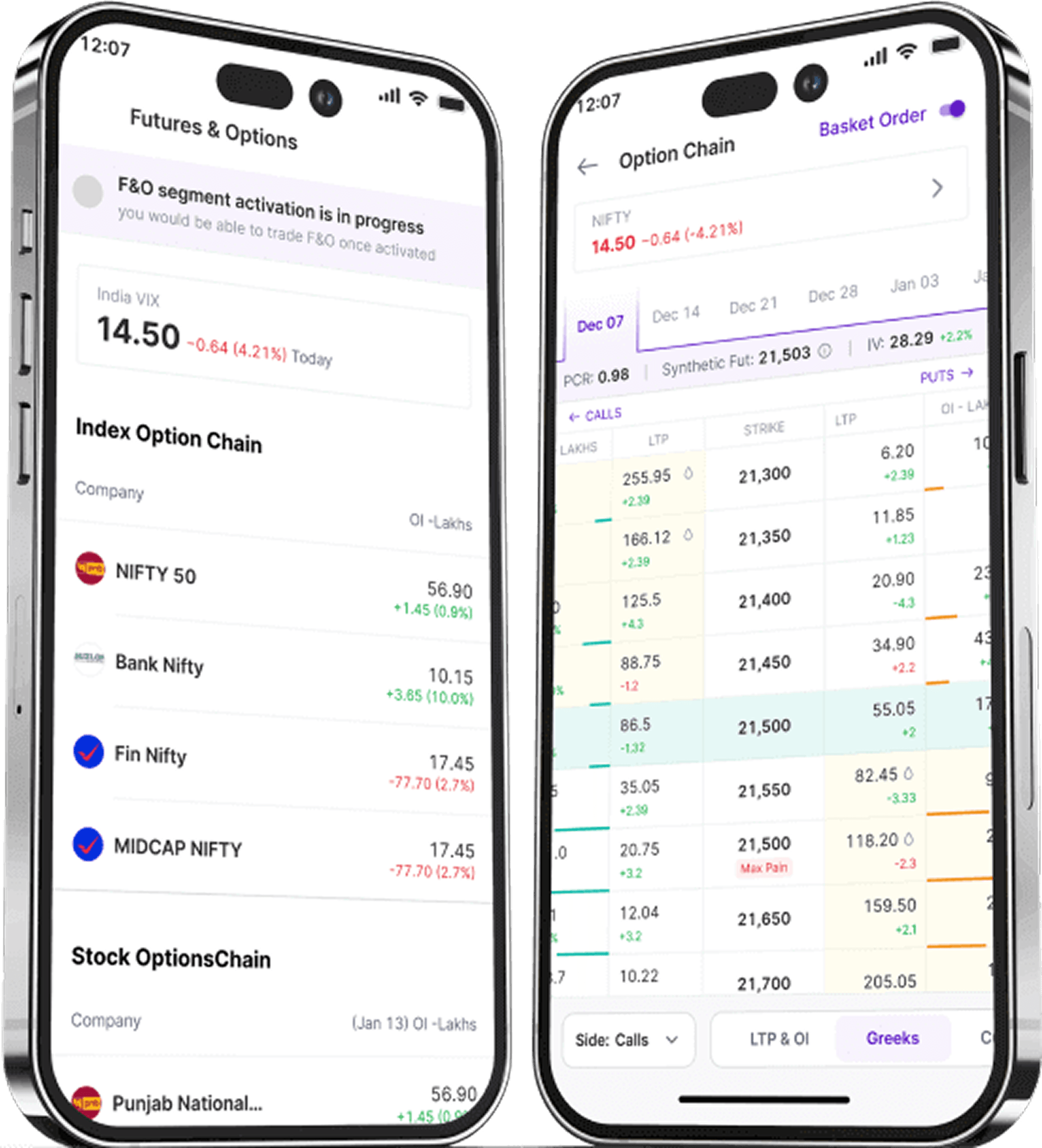
F&O stands for Futures & Options. These derivative contracts allow you to speculate on the future price movements of an underlying asset, such as a stock, index, commodity, or currency.
While futures contracts obligate you to buy or sell the underlying asset at a predetermined price on a specific future date.
Options contracts give you the right, but not the obligation, to buy or sell the underlying asset at a predetermined price by a specific date.
Apart from the fundamental difference that stock F&O contracts are based on individual stocks, while index F&O contracts are based on indices such as Nifty and Sensex, there are other key distinctions.
Futures and options (F&O) trading offers profit potential but carries certain risks. These include leverage amplifying losses, market volatility leading to unexpected downturns, and liquidity issues affecting trade execution. Counterparty default, systemic market disruptions, and timing errors are also concerns. To mitigate, traders should research thoroughly, develop a robust plan, manage leverage wisely, and employ risk management tactics like stop-loss orders.
Futures contracts require a significant initial investment, but trading options can be more cost-effective, mainly depending on the strike price and contract expiration. Option prices typically decrease as contracts near expiration.
Additionally, you can pledge your assets with us to access margins for F&O trading without selling anything.
F&O trading gives you the following benefits which are not available when trading in stocks:
A strike price in options contracts is a price at which the underlying asset can be bought or sold when the option contract is exercised.
For call options, the strike price is the price at which the holder has the right (but not the obligation) to buy the underlying asset. For put options, the strike price is the price at which the holder has the right (but not the obligation) to sell the underlying asset. The strike price is also known as the exercise price.
Expiry in F&O contracts is the date on which the contract must be exercised. When the contract expires, the parties are obligated to fulfil their obligations under the contract, either by settling in cash or by delivery of the underlying asset.
Call options give you the right to buy the underlying asset at a specific price (strike price) by the expiry date. You would typically use a call option if you believe the price of the asset will rise.Put options, on the other hand, give you the right to sell the underlying asset at a specific price (strike price) by the expiry date. You would typically use a put option if you believe the price of the asset will fall.
Margin is a deposit you must provide to the broker to hold an F&O position. It acts as a form of security for the broker and the exchange to ensure that you will be willing to take the inherent risk associated with the position.
If you own stocks, put options can help protect your investment. When you buy a put option, you secure the right to sell your stock at a set price by a specific date. This shields you from potential losses if the stock’s value drops.
Alternatively, if you hold a substantial amount of the underlying stock, selling a futures contract can offer protection. Furthermore, if you have existing futures and options positions, you can use additional F&O contracts to further hedge your positions and manage risk effectively.
If you don't have an account with us, please select the segments for activation, choose Futures and Options, and submit proof of income when opening a new account.
If you already have an account, go to the profile section and open the account information tab. Select the activation option for the Futures and Options segment and upload proof of income to activate it.
PhonePe Invest is SEBI regulated and follows applicable exchange regulations, internal risk policies and security controls.
Enjoy a comprehensive web-based trading platform